Saudi Arabia's Rising Consumer Wave: Why American Startups Can't Afford to Ignore a Generation of New Spenders
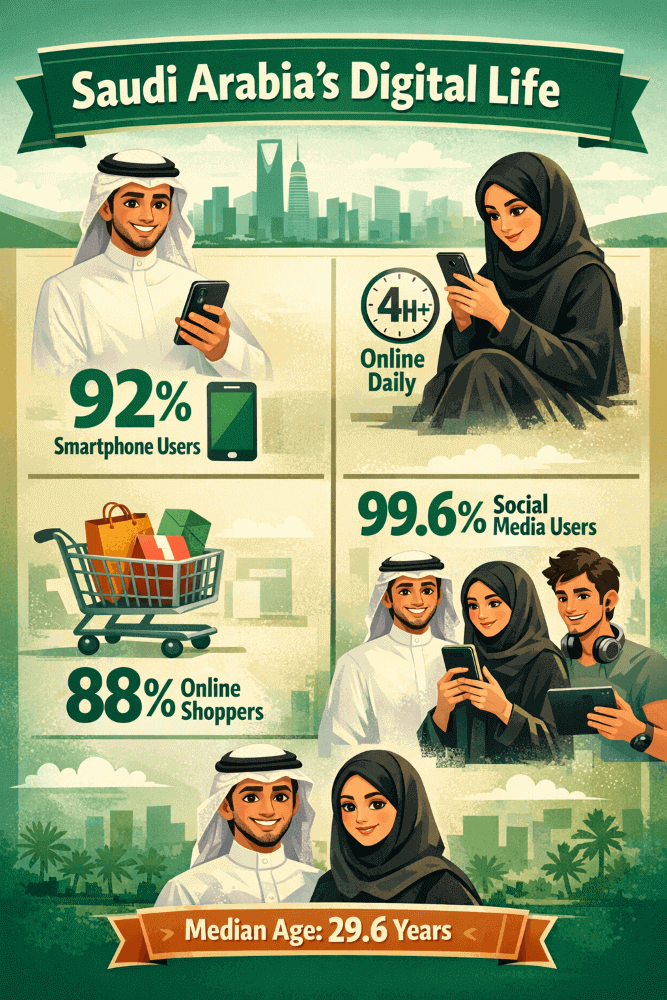
Photo: young Saudi consumers shopping digital mobile technology Riyadh, via propellerads.com
There is a quiet economic transformation underway in Saudi Arabia that has not yet registered on the radar of most American startup founders. While Silicon Valley's attention has been fixed on Southeast Asia, India, and Latin America as the canonical emerging market plays, a consumer class of considerable scale and sophistication has been forming in the Kingdom—one with disposable income, digital fluency, and an appetite for products and services that the local market has only partially learned to satisfy.
The numbers are not speculative. Saudi Arabia's household consumption is projected to grow at a compound annual rate that places total consumer spending on a trajectory toward $2 trillion over the coming decade. The drivers behind that trajectory are structural, not cyclical, which is precisely what makes this moment strategically significant for American companies willing to look beyond the conventional emerging market shortlist.
The Demographic Engine Behind the Spending Surge
Saudi Arabia is a young country. Approximately 63 percent of the population is under the age of 35, and this cohort has grown up in an era defined by smartphone penetration rates that rival or exceed those of the United States. Internet access reaches more than 95 percent of the population. Social media usage per capita ranks among the highest globally. These are not the demographics of a market in early adoption—they are the demographics of a market ready to spend digitally at scale.
Vision 2030's labor market reforms have added a critical economic dimension to this demographic reality. The Saudization program, known formally as Nitaqat, has pushed private sector employment of Saudi nationals significantly higher over the past several years. Female labor force participation—historically one of the lowest rates in the world—has climbed from approximately 17 percent in 2017 to over 33 percent by 2023, a transformation that has both expanded household income and reshaped spending patterns in categories ranging from fashion and beauty to professional services and childcare.
Wage growth among this newly employed cohort is generating first-time discretionary spending at a pace that consumer-facing businesses are scrambling to serve. The middle class is not merely growing in Saudi Arabia—it is being deliberately constructed as a matter of national economic policy.
Where American Startups Have a Structural Advantage
The sectors where American startups are most naturally competitive happen to align closely with where Saudi consumer demand is most acutely underserved.
E-commerce and direct-to-consumer retail represent perhaps the most immediate opportunity. Saudi Arabia's e-commerce market has grown at a pace that consistently outstrips regional forecasts, yet product selection, delivery reliability, and post-purchase customer experience still lag behind what Saudi consumers observe on international platforms. American brands with strong digital retail capabilities—particularly in categories like wellness, outdoor recreation, home goods, and specialty food—face relatively few entrenched local competitors.
Fintech is a sector where regulatory tailwinds and consumer readiness are converging in an unusually favorable way. The Saudi Central Bank (SAMA) has established a regulatory sandbox that has actively welcomed fintech experimentation, and the country's Vision 2030 financial inclusion targets have created institutional appetite for solutions that bring more citizens into the formal financial system. Buy-now-pay-later (BNPL) services, digital lending platforms, and personal financial management tools are all categories where American startups with proven models could find significant traction with modest localization investment.
SaaS platforms targeting the SME segment represent a less obvious but equally promising avenue. Saudi Arabia's Vision 2030 agenda includes an explicit commitment to growing the SME sector's contribution to GDP from roughly 20 percent to 35 percent. That means tens of thousands of newly formed small businesses are entering the market each year, many of them lacking access to the operational software infrastructure—inventory management, payroll, CRM, customer analytics—that American SaaS companies have refined over decades.
Localization Is Not Optional, But It Is Achievable
American founders sometimes conflate localization with complexity and use it as a reason to delay market entry. The Saudi context does require meaningful adaptation—Arabic-language interfaces are not a preference but an expectation for broad consumer adoption, and payment infrastructure must accommodate MADA (Saudi Arabia's domestic debit network) alongside international card schemes. Content and marketing must reflect cultural sensitivities that differ meaningfully from U.S. norms.
None of this is insurmountable. Saudi Arabia's technology ecosystem has matured to the point where credible local partners—product localization agencies, digital marketing firms with Arabic-language capabilities, and regulatory consultants familiar with SAMA and ZATCA requirements—are readily accessible. The cost of localization for a well-prepared American startup is a fraction of the market opportunity it unlocks.
The Competitive Clock Is Running
The strategic risk for American startups is not that Saudi Arabia is too difficult to enter. It is that the window for entering as a first-mover or early-mover in specific categories is compressing. Chinese e-commerce platforms have made significant inroads in the Kingdom's price-sensitive consumer segments. Regional players backed by Saudi sovereign wealth capital are professionalizing rapidly. And a handful of American companies that recognized this opportunity earlier are already building brand equity with Saudi consumers.
The companies that will define category leadership in Saudi Arabia's consumer economy over the next decade are largely those that enter in the next two to three years. For American startups with scalable models, relevant product-market fit, and the operational discipline to localize thoughtfully, Saudi Arabia is not a speculative bet. It is a market with verifiable demand, improving infrastructure, and a government actively seeking the foreign business partnerships that will help it achieve its most ambitious economic transformation in modern history.
The question for American founders is not whether Saudi Arabia is ready for their product. It is whether they are ready for Saudi Arabia.